
Navi Mumbai Real Estate Market 2026 – The Airport-Led Growth Corridor of MMR
Navi Mumbai represents one of the most important long-term growth stories in the Mumbai Metropolitan Region (MMR).
Unlike legacy suburbs such as Andheri or Bandra, Navi Mumbai is:
- Planned
- Spread out
- Infrastructure-led
- Growth-oriented
With the development of the Navi Mumbai International Airport (NMIA), the region has entered a new phase of transformation.
In 2026, Navi Mumbai stands as one of the most compelling appreciation-driven markets in MMR.
This guide covers:
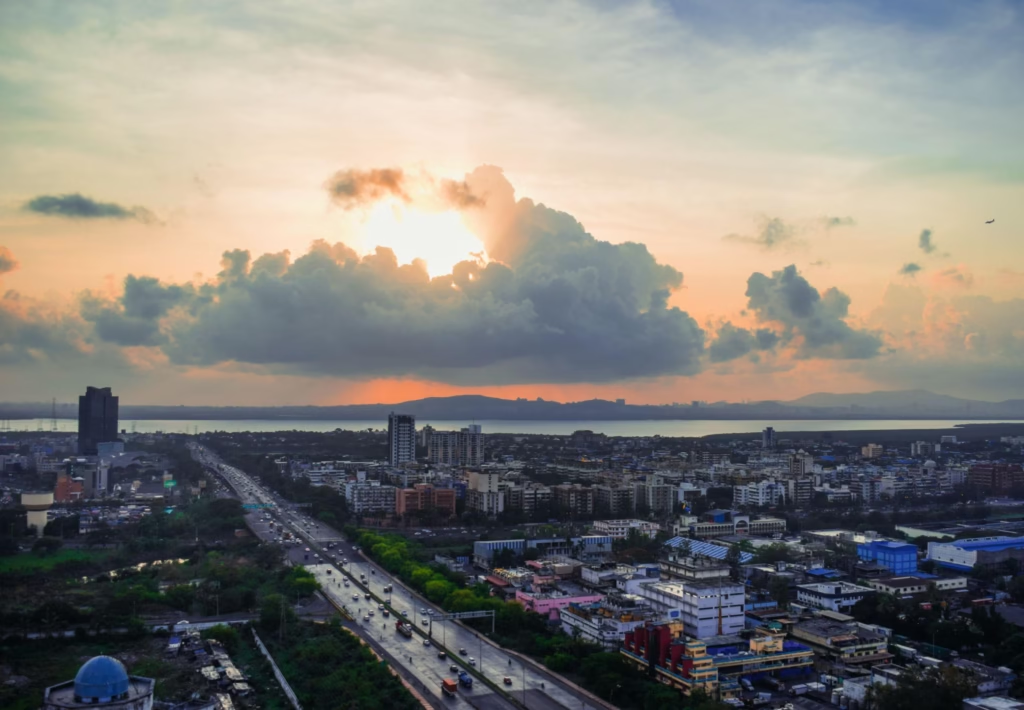
✈ Navi Mumbai International Airport – The Game Changer
The Navi Mumbai International Airport is the single biggest catalyst for regional real estate growth.
The airport is expected to:
- Reduce congestion at Mumbai Airport
- Boost commercial activity
- Increase employment generation
- Trigger hospitality and retail growth
- Improve global connectivity
Airport-led development typically creates multi-year real estate appreciation cycles.
However, appreciation depends on:
- Project execution timelines
- Infrastructure connectivity
- Demand absorption
📍 Why Navi Mumbai Is Structurally Different
Navi Mumbai is not a traditional suburb.
It is a planned satellite city featuring:
- Wide roads
- Sector-based development
- Lower density
- Organized civic planning
Major nodes include:
- Vashi
- Nerul
- Seawoods
- Kharghar
- Panvel
- Ulwe
Each node has its own pricing dynamic.
💰 Navi Mumbai Property Prices (2026 Update)
Average Price Per Sq Ft
| Location | Avg Price Per Sq Ft |
|---|---|
| Vashi | ₹18,000 – ₹28,000 |
| Nerul | ₹15,000 – ₹25,000 |
| Seawoods | ₹18,000 – ₹30,000 |
| Kharghar | ₹12,000 – ₹20,000 |
| Ulwe | ₹10,000 – ₹16,000 |
| Panvel | ₹8,000 – ₹15,000 |
Compared to Mumbai suburbs, Navi Mumbai offers significantly lower entry pricing.
📊 Ticket Size Overview
| Configuration | Price Range |
|---|---|
| 1 BHK | ₹45 Lakhs – ₹90 Lakhs |
| 2 BHK | ₹90 Lakhs – ₹1.8 Cr |
| 3 BHK | ₹1.8 Cr – ₹3.5 Cr |
Premium nodes such as Seawoods command higher pricing.
🏗 Infrastructure Catalysts Beyond the Airport
Navi Mumbai’s growth is also supported by:
- Trans Harbour Link (MTHL)
- Metro expansion
- Palm Beach Road connectivity
- Corporate office growth
- Educational institutions
The Mumbai Trans Harbour Link reduces travel time to South Mumbai dramatically, improving Navi Mumbai’s attractiveness.
🏢 Rental Market – Growing but Selective
Rental demand is strongest in:
- Vashi
- Nerul
- Seawoods
- Kharghar
Tenant profile includes:
- IT professionals
- Corporate employees
- Port and logistics staff
- Families
📊 Rental Range (2026)
| Configuration | Monthly Rent |
|---|---|
| 1 BHK | ₹15,000 – ₹28,000 |
| 2 BHK | ₹28,000 – ₹50,000 |
| 3 BHK | ₹50,000 – ₹85,000 |
Rental Yield
3% – 4.5%
Higher yield potential in Ulwe and Panvel due to lower capital values.
📈 Appreciation Potential
Navi Mumbai’s investment appeal lies in:
- Infrastructure completion
- Airport operationalization
- Commercial growth
Projected 2026–2031 CAGR:
7–10% in select nodes.
Growth is likely to be stronger in:
- Ulwe (airport proximity)
- Panvel (future expansion belt)
- Seawoods (premium lifestyle hub)
However, appreciation may be uneven across nodes.
🧠 Who Should Invest in Navi Mumbai?
✔ Growth-Oriented Investors
Seeking higher CAGR than Mumbai core.
✔ Mid-Income Buyers
Affordable entry pricing.
✔ Long-Term Investors
7–10 year horizon.
✔ Portfolio Diversifiers
Balancing Mumbai investments with growth corridor.
Navi Mumbai is better suited for appreciation-focused investors than yield-only buyers.
⚖ Pros & Cons of Investing in Navi Mumbai
✅ Pros
- Airport-led growth
- Lower entry price
- Strong infrastructure pipeline
- Planned urban layout
- Higher appreciation potential
⚠ Cons
- Execution delays risk
- Supply-heavy market
- Node-specific price variation
- Rental demand not uniform
Navi Mumbai offers higher upside but moderate execution risk.
📊 Navi Mumbai vs Thane vs Chembur
| Factor | Navi Mumbai | Thane | Chembur |
|---|---|---|---|
| Entry Price | Lower | Moderate | Moderate |
| Rental Yield | Strong | Strong | Strong |
| Appreciation | Higher Potential | Higher | Moderate-High |
| Risk | Moderate | Moderate | Moderate |
Navi Mumbai offers the highest upside potential among the three.
🔮 5-Year Outlook (2026–2031)
Expect:
- Airport-driven node appreciation
- Strong investor participation
- Gradual commercial ecosystem growth
- Infrastructure-backed pricing support
If airport operations stabilize and infrastructure execution continues, Navi Mumbai could outperform several Mumbai suburbs in CAGR.
💡 Investment Strategies
Strategy 1: Airport Proximity Bet
Invest in Ulwe or Panvel for long-term appreciation.
Strategy 2: Premium Node Stability
Choose Seawoods or Nerul for balanced rental + growth.
Strategy 3: Diversified Portfolio
Combine Navi Mumbai growth with Mumbai rental asset.
🏁 Final Verdict – Navi Mumbai
Navi Mumbai stands as MMR’s airport-driven expansion corridor.
It offers:
- Lower entry pricing
- Strong infrastructure catalysts
- Higher appreciation potential
- Structured urban planning
For investors willing to accept moderate infrastructure execution risk in exchange for stronger long-term upside, Navi Mumbai real estate in 2026 represents one of the most compelling growth stories in the Mumbai Metropolitan Region.Navi Mumbai Real Estate Market 2026 – The Airport-Led Growth Corridor of MMR
Navi Mumbai represents one of the most important long-term growth stories in the Mumbai Metropolitan Region (MMR).
Unlike legacy suburbs such as Andheri or Bandra, Navi Mumbai is:
- Planned
- Spread out
- Infrastructure-led
- Growth-oriented
With the development of the Navi Mumbai International Airport (NMIA), the region has entered a new phase of transformation.
In 2026, Navi Mumbai stands as one of the most compelling appreciation-driven markets in MMR.
This guide covers:
- Current property prices
- Airport impact
- Infrastructure catalysts
- Rental market
- Appreciation outlook
- Investment strategy
✈ Navi Mumbai International Airport – The Game Changer
The Navi Mumbai International Airport is the single biggest catalyst for regional real estate growth.
The airport is expected to:
- Reduce congestion at Mumbai Airport
- Boost commercial activity
- Increase employment generation
- Trigger hospitality and retail growth
- Improve global connectivity
Airport-led development typically creates multi-year real estate appreciation cycles.
However, appreciation depends on:
- Project execution timelines
- Infrastructure connectivity
- Demand absorption
📍 Why Navi Mumbai Is Structurally Different
Navi Mumbai is not a traditional suburb.
It is a planned satellite city featuring:
- Wide roads
- Sector-based development
- Lower density
- Organized civic planning
Major nodes include:
- Vashi
- Nerul
- Seawoods
- Kharghar
- Panvel
- Ulwe
Each node has its own pricing dynamic.
💰 Navi Mumbai Property Prices (2026 Update)
Average Price Per Sq Ft
| Location | Avg Price Per Sq Ft |
|---|---|
| Vashi | ₹18,000 – ₹28,000 |
| Nerul | ₹15,000 – ₹25,000 |
| Seawoods | ₹18,000 – ₹30,000 |
| Kharghar | ₹12,000 – ₹20,000 |
| Ulwe | ₹10,000 – ₹16,000 |
| Panvel | ₹8,000 – ₹15,000 |
Compared to Mumbai suburbs, Navi Mumbai offers significantly lower entry pricing.
📊 Ticket Size Overview
| Configuration | Price Range |
|---|---|
| 1 BHK | ₹45 Lakhs – ₹90 Lakhs |
| 2 BHK | ₹90 Lakhs – ₹1.8 Cr |
| 3 BHK | ₹1.8 Cr – ₹3.5 Cr |
Premium nodes such as Seawoods command higher pricing.
🏗 Infrastructure Catalysts Beyond the Airport
Navi Mumbai’s growth is also supported by:
- Trans Harbour Link (MTHL)
- Metro expansion
- Palm Beach Road connectivity
- Corporate office growth
- Educational institutions
The Mumbai Trans Harbour Link reduces travel time to South Mumbai dramatically, improving Navi Mumbai’s attractiveness.
🏢 Rental Market – Growing but Selective
Rental demand is strongest in:
- Vashi
- Nerul
- Seawoods
- Kharghar
Tenant profile includes:
- IT professionals
- Corporate employees
- Port and logistics staff
- Families
📊 Rental Range (2026)
| Configuration | Monthly Rent |
|---|---|
| 1 BHK | ₹15,000 – ₹28,000 |
| 2 BHK | ₹28,000 – ₹50,000 |
| 3 BHK | ₹50,000 – ₹85,000 |
Rental Yield
3% – 4.5%
Higher yield potential in Ulwe and Panvel due to lower capital values.
📈 Appreciation Potential
Navi Mumbai’s investment appeal lies in:
- Infrastructure completion
- Airport operationalization
- Commercial growth
Projected 2026–2031 CAGR:
7–10% in select nodes.
Growth is likely to be stronger in:
- Ulwe (airport proximity)
- Panvel (future expansion belt)
- Seawoods (premium lifestyle hub)
However, appreciation may be uneven across nodes.
🧠 Who Should Invest in Navi Mumbai?
✔ Growth-Oriented Investors
Seeking higher CAGR than Mumbai core.
✔ Mid-Income Buyers
Affordable entry pricing.
✔ Long-Term Investors
7–10 year horizon.
✔ Portfolio Diversifiers
Balancing Mumbai investments with growth corridor.
Navi Mumbai is better suited for appreciation-focused investors than yield-only buyers.
⚖ Pros & Cons of Investing in Navi Mumbai
✅ Pros
- Airport-led growth
- Lower entry price
- Strong infrastructure pipeline
- Planned urban layout
- Higher appreciation potential
⚠ Cons
- Execution delays risk
- Supply-heavy market
- Node-specific price variation
- Rental demand not uniform
Navi Mumbai offers higher upside but moderate execution risk.
📊 Navi Mumbai vs Thane vs Chembur
| Factor | Navi Mumbai | Thane | Chembur |
|---|---|---|---|
| Entry Price | Lower | Moderate | Moderate |
| Rental Yield | Strong | Strong | Strong |
| Appreciation | Higher Potential | Higher | Moderate-High |
| Risk | Moderate | Moderate | Moderate |
Navi Mumbai offers the highest upside potential among the three.
🔮 5-Year Outlook (2026–2031)
Expect:
- Airport-driven node appreciation
- Strong investor participation
- Gradual commercial ecosystem growth
- Infrastructure-backed pricing support
If airport operations stabilize and infrastructure execution continues, Navi Mumbai could outperform several Mumbai suburbs in CAGR.
💡 Investment Strategies
Strategy 1: Airport Proximity Bet
Invest in Ulwe or Panvel for long-term appreciation.
Strategy 2: Premium Node Stability
Choose Seawoods or Nerul for balanced rental + growth.
Strategy 3: Diversified Portfolio
Combine Navi Mumbai growth with Mumbai rental asset.
🏁 Final Verdict – Navi Mumbai
Navi Mumbai stands as MMR’s airport-driven expansion corridor.
It offers:
- Lower entry pricing
- Strong infrastructure catalysts
- Higher appreciation potential
- Structured urban planning
For investors willing to accept moderate infrastructure execution risk in exchange for stronger long-term upside, Navi Mumbai real estate in 2026 represents one of the most compelling growth stories in the Mumbai Metropolitan Region.