
Redevelopment disputes between housing societies and developers are becoming increasingly common across Mumbai. In a significant ruling, the Bombay High Court intervened in a stalled redevelopment project in Mulund and directed the developer to hand over control of the project to the housing society.
The judgment highlights the rights of cooperative housing societies when developers fail to meet their contractual obligations.
The case involved Mulund Endeavour Co-operative Housing Society Ltd. and developer Alag Property and Constructions Pvt. Ltd., with Advocate Karl Tamboly appearing for the developer before the Bombay High Court.
Background of the Mulund Redevelopment Project
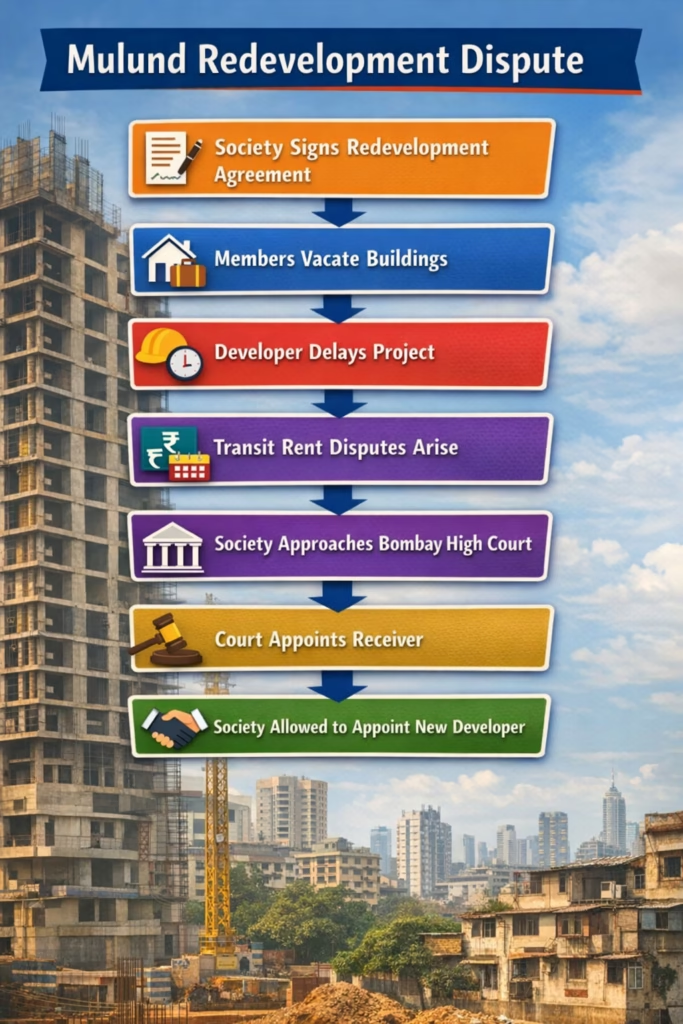
The dispute arose from a redevelopment agreement executed in July 2016 between the housing society and the developer.
Key project details:
- Location: Mulund, Mumbai
- Land Area: Approximately 4182 square meters
- Existing Structures: Four residential buildings
- Proposed Development: Three residential towers with multiple floors
Under the redevelopment agreement, the developer was required to:
- Demolish the existing buildings
- Construct new residential towers
- Provide permanent alternate accommodation to members
- Pay transit rent until project completion
However, the redevelopment project reportedly faced serious delays, leading to disputes between the society and the developer.
Allegations by the Housing Society
The society approached the Bombay High Court alleging that the developer had failed to perform obligations under the redevelopment agreement.
Key allegations included:
- Severe project delay despite the contractual timeline.
- Incomplete construction, with only a portion of the project completed.
- Non-payment of transit rent to society members for an extended period.
- Outstanding financial obligations including arrears payable to members.
- Non-payment of certain municipal dues associated with the project.
Many members had already vacated their homes and were living in temporary accommodation while awaiting completion of the redevelopment project.
The society therefore sought court intervention to protect the interests of its members.
Arguments Presented by Advocate Karl Tamboly
Appearing for the developer, Advocate Karl Tamboly presented arguments defending the developer’s position.
The developer contended that:
- Significant investments had already been made in the project.
- A substantial portion of construction had been completed.
- Certain delays were attributable to external factors including the COVID-19 pandemic and operational challenges.
- Termination of the redevelopment agreement would cause serious financial and contractual consequences.
The developer therefore sought relief from the court and argued against the immediate termination of the redevelopment arrangement.
Bombay High Court’s Observations
The Bombay High Court examined the contractual obligations and the progress of the redevelopment project.
The court noted several important factors:
- The rights of displaced housing society members must be protected.
- Redevelopment agreements impose clear obligations on developers regarding timelines and payments.
- Courts may intervene when redevelopment projects remain stalled for prolonged periods.
The court also emphasized that housing societies cannot be left in a situation where members remain displaced while redevelopment remains uncertain.
Bombay High Court Decision
After considering the submissions and circumstances of the case, the Bombay High Court granted relief to the housing society.
Key directions included:
- The developer was directed to hand over control of the redevelopment project.
- A Court Receiver was appointed to take possession of the redevelopment site.
- The housing society was permitted to take steps to appoint a new developer for completion of the project.
- The developer’s request for a stay on the order was rejected.
This decision effectively allowed the society to move forward with redevelopment after years of delay.
Legal Principles From the Judgment
The judgment reinforces several important legal principles in Mumbai redevelopment law.
1. Developers Must Honour Contractual Timelines
Redevelopment agreements impose strict obligations on developers regarding:
- Construction timelines
- Transit rent payments
- Project completion
Failure to meet these obligations may justify judicial intervention.
2. Housing Society Members Must Be Protected
When members vacate their homes for redevelopment, courts may intervene to ensure that:
- Members are not left without housing indefinitely
- Developers fulfill their contractual commitments
3. Courts Can Remove Defaulting Developers
In serious cases of delay or breach, courts may:
- Suspend the developer’s rights
- Appoint a Court Receiver
- Permit the housing society to appoint a new developer
What This Judgment Means for Mumbai Redevelopment
The ruling is particularly important because redevelopment projects are a major component of Mumbai’s urban housing policy.
Thousands of housing societies across the city rely on redevelopment to upgrade aging buildings.
However, disputes often arise due to:
- Project delays
- Financial disputes
- Developer defaults
This judgment confirms that housing societies have legal remedies when redevelopment projects stall.
Practical Lessons for Housing Societies
Housing societies involved in redevelopment should:
- Carefully draft redevelopment agreements
- Monitor project timelines
- Ensure compliance with contractual obligations
- Seek legal remedies if developers fail to perform
Early legal intervention can prevent long-term project delays.
FAQ – Redevelopment Disputes in Mumbai
Can a housing society remove a developer from a redevelopment project?
Yes. If the developer breaches the redevelopment agreement or delays the project, the society may approach the court for relief.
What happens if a redevelopment project is delayed?
The housing society may seek legal remedies including:
- Termination of the agreement
- Appointment of a new developer
- Court supervision of the project
What is transit rent in redevelopment?
Transit rent is the compensation paid by the developer to society members who vacate their homes during redevelopment.
Can the Bombay High Court intervene in redevelopment disputes?
Yes. The Bombay High Court frequently hears redevelopment disputes involving cooperative housing societies and developers.
Conclusion
The Mulund redevelopment dispute judgment highlights the growing legal scrutiny of stalled redevelopment projects in Mumbai.
By directing the developer to hand over the project, the Bombay High Court reaffirmed that housing societies have legal protection when redevelopment projects fail to progress as promised.
For cooperative housing societies across Mumbai, the ruling serves as a reminder that redevelopment agreements carry enforceable obligations and courts can step in when those obligations are breached.
123bhk Editorial Disclaimer
The content published on 123bhk.in is intended solely for informational, journalistic, and educational purposes related to real estate, housing society governance, redevelopment matters, and legal developments affecting the property sector.
While reasonable efforts are made to ensure that the information presented in articles, case analyses, and reports is accurate and based on publicly available sources such as court orders, government notifications, regulatory publications, and credible news reports, 123bhk.in does not guarantee the completeness, reliability, or accuracy of the information contained on this website.
Articles discussing court judgments, legal disputes, redevelopment matters, or housing society issues are intended to provide a general understanding of the subject matter. Such content should not be interpreted as legal advice, financial advice, investment advice, or professional consultation.
Readers are strongly advised to seek independent legal or professional advice from qualified lawyers, chartered accountants, or real estate professionals before taking any action based on information published on this website.
References to individuals, companies, housing societies, developers, advocates, or projects are made solely for the purpose of reporting or discussing publicly available information, court proceedings, or industry developments. Nothing contained in the article is intended to make allegations, accusations, or defamatory statements against any person or entity.
Where disputes or legal proceedings are discussed, the information reflects reported facts or court observations available in the public domain at the time of publication, and such matters may evolve over time through appeals, settlements, or subsequent court orders.
123bhk.in shall not be liable for any loss, damage, or consequences arising from reliance on information published on the website, including but not limited to real estate investments, redevelopment decisions, housing society disputes, or legal actions.
Readers acknowledge that real estate transactions and redevelopment projects involve significant legal and financial considerations, and independent verification and professional consultation are essential before making decisions.
By accessing or using this website, readers agree that the use of information provided on 123bhk.in is entirely at their own discretion and risk.