
🏢 Introduction
Cooperative Housing Societies (CHS) in Maharashtra function according to Model Bye Laws issued under the Maharashtra Cooperative Societies Act.
However, societies may need to amend their bye laws due to:
- Redevelopment decisions
- Parking policy changes
- Maintenance calculation updates
- Digital voting introduction
- Compliance with new government notifications
Amending bye laws is a structured legal process — it cannot be done casually or by committee decision alone.
This guide explains the complete legal procedure.
1️⃣ What Are CHS Bye Laws?
Bye laws are internal rules that govern:
- Membership eligibility
- Maintenance charges
- Committee powers
- Parking allotment
- Transfer charges
- Redevelopment process
- Dispute handling
They operate within the framework of the Maharashtra Cooperative Societies Act.
Societies cannot adopt bye laws that conflict with state law.
2️⃣ When Can Bye Laws Be Amended?
Amendment may be required when:
- Government issues revised Model Bye Laws
- Society wants to change maintenance formula
- Redevelopment clause modification needed
- Digital payment systems introduced
- Parking rotation policy updated
Amendment must be in interest of society.
3️⃣ Step-by-Step Procedure to Amend CHS Bye Laws
Step 1: Committee Resolution
Managing Committee must:
- Draft proposed amendment.
- Record reason for change.
- Pass committee resolution to call Special General Meeting (SGM).
Committee alone cannot implement amendment.
Step 2: Notice of Special General Meeting (SGM)
Society must:
- Issue written notice to all members.
- Mention exact proposed amendment text.
- Provide minimum notice period (usually 14 days).
Transparency is mandatory.
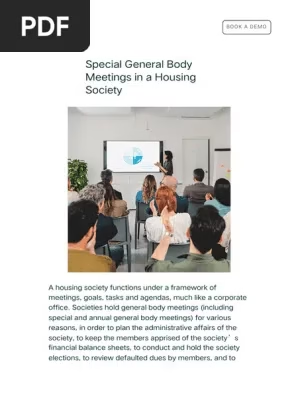
Step 3: Conduct Special General Meeting
During SGM:
- Proposed amendment is discussed.
- Members can debate.
- Voting is conducted.
Proper quorum must be present.
4️⃣ Voting Requirement – 2/3 Majority Rule
To pass amendment:
👉 Minimum 2/3 majority of members present and voting must approve.
Important:
- It is not 2/3 of total members.
- It is 2/3 of members present and voting.
- Proxy voting rules must be followed.
Minutes must clearly record voting outcome.
5️⃣ Submission to Registrar for Approval
After SGM approval:
Society must:
- Submit amendment proposal.
- Attach SGM minutes.
- Attach attendance sheet.
- Submit certified resolution copy.
Registrar examines:
- Whether amendment conflicts with law.
- Whether procedure was followed properly.
Amendment becomes effective only after Registrar approval.
6️⃣ Can Society Amend Government-Mandated Bye Laws?
Society cannot:
❌ Override statutory provisions
❌ Change maximum transfer fee limit
❌ Increase non-occupancy beyond legal cap
❌ Override 75% redevelopment rule
Amendments must remain within legal framework.
7️⃣ Common Amendments in Maharashtra Societies
- Changing maintenance formula
- Introducing parking rotation system
- Digital voting system
- Increasing penalty interest (within limit)
- Redevelopment clause strengthening
- Green building compliance rules
Each must follow proper procedure.
8️⃣ What If Amendment Is Passed Improperly?
If:
- No proper notice issued
- Quorum absent
- Voting manipulated
- Registrar approval not obtained
Then amendment is invalid.
Members can challenge before:
- Assistant Registrar
- Cooperative Court
9️⃣ Timeline for Amendment Approval
Approximate timeline:
- Committee resolution: 1–2 weeks
- Notice period: 14 days
- SGM & voting: 1 day
- Registrar approval: 1–3 months (varies)
Until Registrar approval, old bye laws continue.
🔟 Amendment During Redevelopment
During redevelopment:
Society may amend bye laws to:
- Strengthen consent procedure
- Introduce PMC requirement
- Clarify corpus distribution method
- Set redevelopment committee structure
However, amendment cannot bypass 75% rule.
1️⃣1️⃣ Can Members Propose Amendment?
Yes.
If sufficient members demand:
- Written requisition submitted.
- Committee must call SGM.
If committee refuses:
Members can approach Registrar.
1️⃣2️⃣ Digital & Modern Governance Amendments
Many Mumbai societies now amend bye laws to include:
- Online maintenance payment
- E-voting
- CCTV compliance
- EV charging guidelines
- Data privacy clauses
Such modernization is increasing.
1️⃣3️⃣ Risks of Improper Amendment
Improper amendment may cause:
- Legal challenge
- Redevelopment delay
- Financial liability
- Registrar intervention
- Committee disqualification
Proper documentation prevents disputes.
📊 Quick Summary Table
| Step | Requirement |
|---|---|
| Committee Resolution | Mandatory |
| SGM Notice | Minimum notice period |
| Voting | 2/3 majority |
| Registrar Approval | Compulsory |
| Immediate Effect? | No, only after approval |
❓ Frequently Asked Questions
Can committee change bye laws alone?
No.
Is 2/3 majority of total members required?
No, of members present and voting.
When does amendment become valid?
After Registrar approval.
Can society increase transfer premium via amendment?
No, statutory cap applies.
Can amendment be challenged?
Yes, if procedure improper.
🏁 Conclusion
Amending CHS bye laws is a powerful governance tool — but it must be done legally and transparently.
In Maharashtra:
- Committee proposes.
- Members approve via 2/3 majority.
- Registrar grants final approval.
Improper amendments can lead to disputes, especially during redevelopment or financial restructuring.
Societies in Mumbai and Thane must follow procedure strictly to avoid litigation.
Disclaimer: This is not legal advice. Kindly consult a qualified lawyer or legal professional for advice specific to your situation.