
Introduction
One of the most common disputes in Cooperative Housing Societies (CHS) across Mumbai, Thane, Pune and Navi Mumbai is related to maintenance charges.
Questions like:
- Why is my maintenance so high?
- Can society charge per square foot?
- Is sinking fund compulsory?
- Can society charge interest on delay?
- Are commercial units charged differently?
These are governed by Model Bye Laws 65 to 71 under the Maharashtra Cooperative Societies framework.
This guide explains maintenance calculation in simple terms.
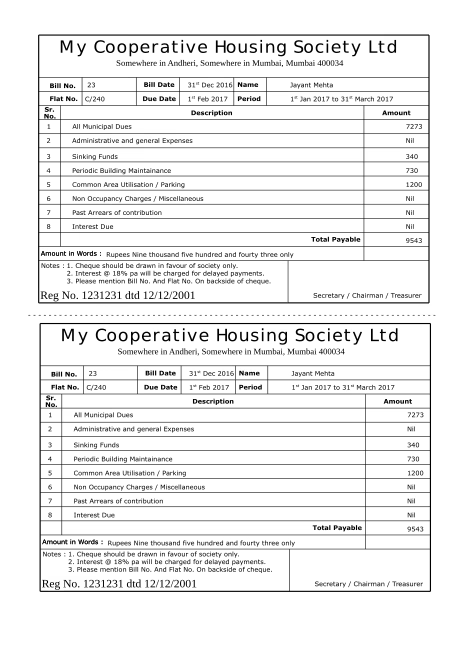
1️⃣ What Is Included in CHS Maintenance?
Maintenance charges are collected to cover:
- Common electricity
- Lift maintenance
- Security salary
- Housekeeping
- Water charges
- Repairs & maintenance
- Insurance
- Audit fees
- Property tax (if common areas)
- Sinking fund contribution
It does NOT include personal flat electricity or individual property tax.
2️⃣ How Maintenance Charges Are Divided (Legal Structure)
As per Bye Laws, maintenance is divided into two major components:
A) Service Charges (Equal Distribution)
These are divided equally among all flats:
- Security
- Lift operator
- Common electricity
- Office expenses
- Audit fees
- Administrative expenses
Each flat pays equal share regardless of size.
B) Area-Based Charges (Per Sq Ft)
These include:
- Repair & maintenance fund
- Sinking fund
- Major structural expenses
These are calculated based on carpet/built-up area (depending on society resolution).
3️⃣ Can Society Charge Only Per Square Foot?
No.
This is a common illegal practice.
As per bye laws:
- Some components must be equally divided.
- Some components can be area-based.
If entire maintenance is charged per sq ft → it may violate bye laws.
Members can challenge such calculation.
4️⃣ What Is Sinking Fund?
Sinking fund is mandatory.
Purpose:
- Major structural repairs
- Building repainting
- Waterproofing
- Lift replacement
- Long-term capital expenses
Contribution:
Minimum 0.25% of construction cost annually (as per guidelines).
This fund cannot be used for routine expenses.
5️⃣ What Is Repair & Maintenance Fund?
This is for regular upkeep:
- Plumbing repairs
- Electrical repairs
- Minor structural work
This is different from sinking fund.
Many societies mix both incorrectly.
6️⃣ Water Charges Calculation
Water charges can be divided:
- Equally
- Based on number of inlets
- Based on usage (if meters installed)
If water meter exists → usage-based billing preferred.
7️⃣ Can Commercial Units Be Charged More?
Yes, but only if:
- Bye laws allow
- General Body approves
- Justification exists (higher usage)
Arbitrary higher charges are illegal.
8️⃣ Interest on Late Payment
Society can charge interest on delayed maintenance.
Maximum rate:
21% per annum (as per bye laws).
However:
- Must be approved in AGM
- Must be mentioned in demand notice
9️⃣ Non-Occupancy Charges (Separate from Maintenance)
If flat is rented:
Society can charge non-occupancy charges.
Maximum:
10% of service charges (not total maintenance).
Many societies illegally charge more.
🔟 Parking Charges
Parking charges:
- Can be levied separately
- Must be reasonable
- Cannot be discriminatory
Parking cannot become profit-making source.
1️⃣1️⃣ Can Society Increase Maintenance Anytime?
No.
Increase must:
- Be based on annual budget
- Be approved in AGM
- Be transparently calculated
Arbitrary hikes can be challenged.
1️⃣2️⃣ Right to Inspect Accounts
Members have legal right to:
- Inspect balance sheet
- Review expenditure details
- Check contractor payments
- Verify sinking fund investments
Refusal is illegal.
1️⃣3️⃣ What If Maintenance Is Not Paid?
Society can:
- Charge interest
- Issue demand notice
- Initiate recovery proceedings
- Approach cooperative court
However, society cannot:
❌ Disconnect water
❌ Stop lift access
❌ Seal flat
That is illegal.
1️⃣4️⃣ Maintenance During Redevelopment
In Mumbai redevelopment cases:
- Corpus interest may offset maintenance
- Transit rent period may suspend some charges
- Developer may pay certain expenses
Members must review redevelopment agreement carefully.
1️⃣5️⃣ Common Maintenance Disputes in Maharashtra
- Entire maintenance charged per sq ft
- Excess sinking fund collection
- Illegal parking rent
- Interest without approval
- No transparency in accounts
- Hidden contractor commissions
Proper documentation is essential before complaint.
📊 Example Calculation (Illustration)
Assume:
Total Monthly Expenses = ₹2,00,000
Total Flats = 20
Average Flat Area = 1,000 sq ft
Service Charges (Equal Portion): ₹1,00,000
Each flat pays: ₹5,000
Area-Based Charges (₹1,00,000):
Per sq ft = ₹5
Flat of 1,000 sq ft pays: ₹5,000
Total Maintenance = ₹10,000
📋 Quick Summary Table
| Component | Calculation Method |
|---|---|
| Security | Equal division |
| Lift | Equal division |
| Sinking Fund | Per sq ft |
| Repair Fund | Per sq ft |
| Water | Equal or usage-based |
| Interest | Max 21% p.a. |
| Non-Occupancy | Max 10% of service charges |
❓ Frequently Asked Questions
Can society charge maintenance per sq ft only?
No. Certain components must be equally divided.
Is sinking fund compulsory?
Yes.
Can society disconnect water for non-payment?
No. Illegal.
Can maintenance be increased mid-year?
Only with proper resolution.
Can members demand audited statement?
Yes. Legal right.
🏁 Conclusion
Maintenance charges are essential for smooth functioning of a Cooperative Housing Society. However, misuse, overcharging and non-transparent accounting are common causes of disputes in Maharashtra.
Understanding Bye Laws 65–71 empowers members to:
- Question illegal charges
- Verify calculation methods
- Protect sinking fund contributions
- Ensure transparent governance
In cities like Mumbai and Thane — where maintenance can reach ₹8–₹20 per sq ft — clarity on calculation method is critical to prevent financial exploitation.
Disclaimer: This is not legal advice. Kindly consult a qualified lawyer or legal professional for advice specific to your situation.