
Redevelopment disputes in Mumbai often arise when a minority flat owner opposes the project approved by the housing society. In a significant ruling, the Bombay High Court clarified that a dissenting flat owner who has not signed the redevelopment agreement cannot be compelled to participate in arbitration under that agreement.
The judgment, delivered by Justice Sandeep V. Marne, came in the case of M/s Space Master Realtors v. Mulund Sandhyaprakash Co‑operative Housing Society Ltd.. The ruling addresses a recurring legal issue in redevelopment projects across Mumbai—whether a non-signatory flat owner can be bound by contractual arbitration clauses executed by the housing society.
High Court Order Copy M/s Space Master Realtors v. Mulund Sandhyaprakash Co‑operative Housing Society Ltd
Background of the Dispute
The dispute arose from the redevelopment of a cooperative housing society located in Mulund, Mumbai.
The society had 11 members and passed a resolution approving redevelopment of the building. Following this resolution:
-
- A Development Agreement (DA) was executed between the society and the developer.
-
- Most members vacated their premises to facilitate redevelopment.
-
- However, one member refused to vacate and opposed the redevelopment project.
The developer initiated legal proceedings seeking possession of the flat so that demolition and redevelopment could proceed.
Eventually, the court ordered the member to vacate the premises and a Court Receiver took possession of the property, allowing the redevelopment project to move forward.
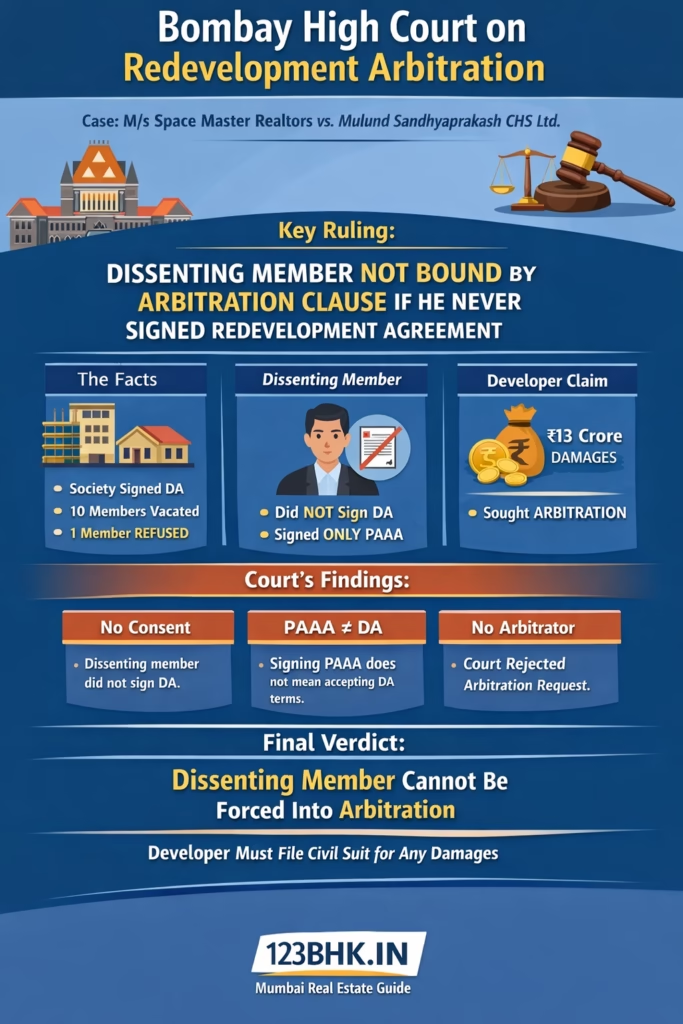
Subsequently, the dissenting member executed a Permanent Alternate Accommodation Agreement (PAAA) to secure his entitlement to a flat in the redeveloped building.
Developer’s Claim for Damages
After redevelopment commenced, the developer claimed that the dissenting member’s refusal to vacate the premises caused:
-
- Delay in demolition and construction
-
- Escalation in construction costs
-
- Financial losses and disruption to the project timeline
The developer claimed damages of approximately ₹13.13 crore and invoked the arbitration clause contained in the redevelopment agreement.
To pursue this claim, the developer filed an application under Section 11 of the Arbitration and Conciliation Act, 1996, seeking appointment of an arbitrator.
Key Legal Issue Before the Court
The principal legal question was:
Can a dissenting flat owner who never signed the redevelopment agreement be compelled to participate in arbitration under that agreement?
The developer argued that the redevelopment agreement executed by the society should bind all members of the society, including dissenting members.
Arguments Presented by the Parties
Developer’s Position
The developer contended that:
-
- The redevelopment project was approved by the housing society through a valid resolution.
-
- The Development Agreement and PAAA formed part of a composite transaction governing redevelopment.
-
- The dissenting member ultimately benefited from the redevelopment project by signing the PAAA.
On this basis, the developer argued that the member should be treated as a “veritable party” to the arbitration agreement.
The developer relied on several Supreme Court decisions concerning the non-signatory doctrine, including the landmark ruling in Cox and Kings Ltd. v. SAP India Pvt. Ltd..
Dissenting Member’s Position
The dissenting member argued that:
-
- He never signed the Development Agreement containing the arbitration clause.
-
- Arbitration proceedings require clear consent between the parties.
-
- The PAAA executed later only governed rehabilitation rights, not redevelopment obligations.
Therefore, the arbitration clause in the Development Agreement could not be enforced against him.
Court’s Analysis
The High Court examined the fundamental principle that arbitration is based on consent.
While courts have recognised limited situations where non-signatories may be bound by arbitration agreements, the court emphasised that such circumstances require:
-
- Clear intention of the parties
-
- Active participation in the contractual arrangement
-
- Evidence that the non-signatory accepted the obligations under the contract
The court noted that in this case:
-
- The dissenting member never signed the Development Agreement.
-
- His later execution of a Permanent Alternate Accommodation Agreement (PAAA) did not automatically incorporate the arbitration clause contained in the redevelopment agreement.
The court also considered the argument that a member of a cooperative society loses individual identity once the society executes a redevelopment agreement. However, the court clarified that this principle does not automatically extend to arbitration consent.
Reference Judgments Considered
While deciding the matter, the court examined several important precedents, including:
-
- Cox and Kings Ltd. v. SAP India Pvt. Ltd.
-
- Chloro Controls India Pvt. Ltd. v. Severn Trent Water Purification Inc.
-
- Daman Singh v. State of Punjab
These cases addressed situations where arbitration clauses may bind parties who did not formally sign the agreement.
However, the High Court concluded that the facts of the redevelopment dispute did not justify extending the arbitration clause to the dissenting member.
Court’s Final Decision
The court held that:
-
- A non-signatory flat owner cannot be compelled to arbitrate disputes under a redevelopment agreement that he never signed.
-
- Execution of a PAAA after redevelopment begins does not imply acceptance of the arbitration clause in the Development Agreement.
Accordingly, the High Court refused to appoint an arbitrator under Section 11 of the Arbitration and Conciliation Act.
This means that if the developer wishes to pursue damages against the dissenting member, the claim must be filed before a civil court rather than through arbitration proceedings.
Implications for Mumbai Redevelopment Projects
The ruling provides important clarity for redevelopment disputes involving dissenting members.
Key takeaways include:
-
- Housing societies may approve redevelopment through majority decisions.
-
- However, individual flat owners cannot automatically be bound by arbitration clauses unless they consent to them.
-
- Developers seeking damages against dissenting members may need to pursue remedies through civil litigation instead of arbitration.
The judgment therefore reinforces the principle that arbitration is a consensual dispute resolution mechanism, and contractual clauses cannot be imposed on parties who have not agreed to them.
Conclusion
The decision of the Bombay High Court in the Space Master Realtors case highlights the delicate balance between society-approved redevelopment and individual contractual rights of flat owners.
While redevelopment projects often proceed based on majority decisions of cooperative housing societies, the court reaffirmed that arbitration clauses remain strictly contractual in nature and cannot bind non-signatory members without explicit consent.
The ruling is expected to influence future redevelopment disputes in Mumbai, particularly in cases involving dissenting flat owners and arbitration claims by developers.
Parties and Advocates
Applicant
M/s Space Master Realtors
(Developer)
Advocates for the Applicant
-
- Mayur Khandeparkar
-
- Vikramjit Garewal
-
- Vishwanath Patil
-
- Nidhi Chauhan
Instructed by:
-
- Akshay Naidu
Respondent No.1
Mulund Sandhyaprakash Co-operative Housing Society Ltd.
Advocate for Respondent No.1
-
- Dhruvin J. Modi
Respondent No.2
Dissenting Flat Owner / Member of the Society
Advocates for Respondent No.2
-
- Karl Tamboly
-
- Ryan D’Souza
-
- Meezan Patel
-
- Harshada Kamble
Judge
The matter was decided by Justice Sandeep V. Marne of the Bombay High Court.
Disclaimer
The information contained in this article is published for general informational and educational purposes only. The content is based on publicly available court records, legal reports, and news sources, including judgments of the Bombay High Court. While every effort has been made to ensure the accuracy and reliability of the information presented, 123bhk.in makes no representations or warranties of any kind, express or implied, regarding the completeness, accuracy, reliability, suitability, or availability of the information contained in this article.
This article does not constitute legal advice, legal opinion, or professional consultation. Readers should not rely solely on the information contained herein for making legal or financial decisions. For specific legal guidance relating to redevelopment disputes, housing society matters, or real estate transactions, readers are advised to consult a qualified legal professional.
The views expressed in this article are based on judicial findings and publicly reported facts. The publication of this content does not imply any endorsement, criticism, or legal conclusion regarding any party involved in the matter.
123bhk.in shall not be held liable for any loss or damage arising directly or indirectly from the use of, or reliance upon, the information contained in this article.
All trademarks, names, and references to legal cases, institutions, and organizations belong to their respective owners. Court decisions cited in this article are subject to further appeals, legal developments, or modifications by higher courts.
By accessing and reading this article, readers acknowledge that they do so at their own discretion and agree that 123bhk.in bears no responsibility for any actions taken based on the information provided.