
A deep dive into the ongoing legal battle over MHADA’s cluster redevelopment push in South Mumbai’s prime real estate belt
Overview
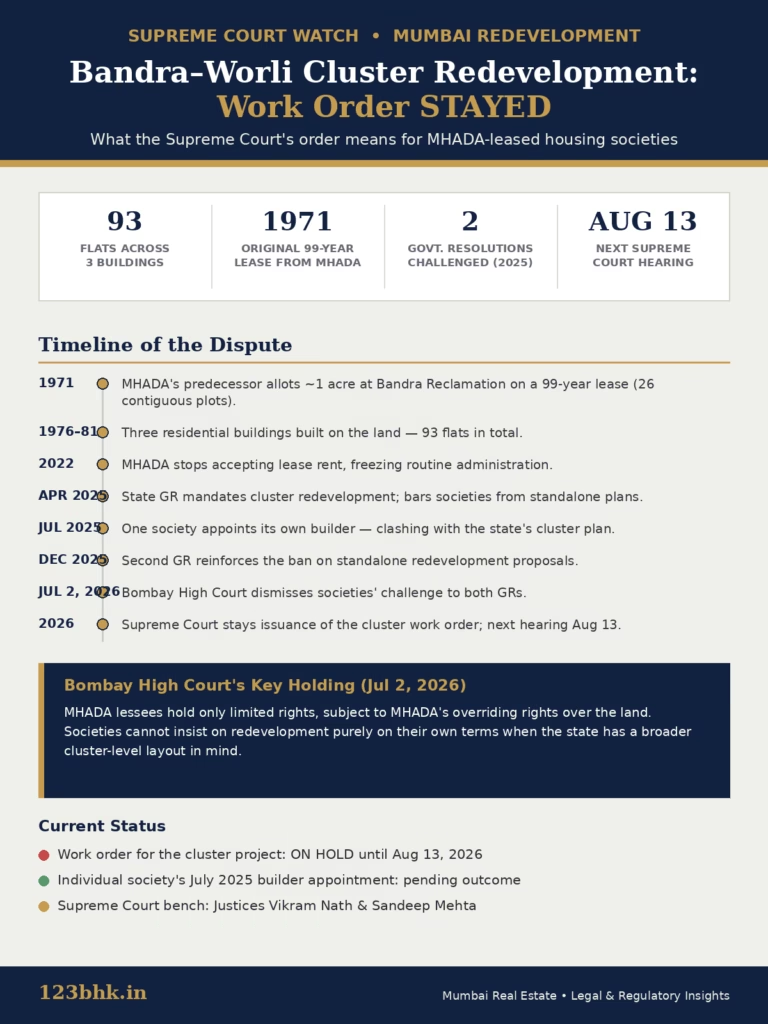
Mumbai’s redevelopment landscape has hit another roadblock. The Supreme Court has stayed the issuance of a work order for a large-scale cluster redevelopment project covering housing societies in Bandra and Worli, two of the city’s most sought-after residential pockets. The matter, which pits individual co-operative housing societies against the state government’s redevelopment machinery, will next be heard on August 13. This report (based on coverage in the Times of India) lays out the timeline, the parties involved, and why this case could set an important precedent for how “cluster redevelopment” is rolled out across Mumbai.
At the heart of the dispute is a familiar tension in Mumbai’s redevelopment story: societies that want to control their own redevelopment versus a state-driven push to consolidate multiple adjoining plots into single, larger “cluster” projects — ostensibly for better planning, infrastructure, and land use, but often at the cost of individual societies’ autonomy.
Background: How the Bandra Reclamation Plot Came to Be
The origins of this dispute go back more than five decades. In 1971, the Maharashtra Housing Board allotted a roughly one-acre plot at Bandra Reclamation to a housing society on a 99-year lease. The allotment covered 26 contiguous plots of land in the area, and it was this same predecessor authority that would later evolve into what is now the Maharashtra Housing and Area Development Authority (MHADA).
Between 1976 and 1981, three residential buildings were constructed on this land, comprising 93 flats. For decades, these buildings functioned as fairly ordinary co-operative housing societies — until the question of redevelopment, and who controls it, took center stage.
In 2022, MHADA stopped accepting lease rent from the societies, effectively freezing a routine administrative process and signalling the start of a more adversarial phase in the relationship between the housing societies and the authority.
By July 2025, at least one of the affected societies had gone ahead and appointed its own builder for redevelopment — a move that would soon collide head-on with the state’s parallel plans for the same land.
The State’s Cluster Redevelopment Push
Around the same time, the state government began pursuing a very different vision for the same stretch of land. In April 2025, a state Government Resolution (GR) directed cluster redevelopment for the Bandra-Worli housing societies, explicitly barring individual societies from pursuing their own, standalone redevelopment plans.
This was followed in December 2025 by a further GR that reinforced the prohibition on standalone redevelopment proposals — effectively locking individual societies out of the redevelopment process and funnelling everything through a single, consolidated cluster scheme.
By April 2026, MHADA and the Solicitor General’s office had appointed senior counsel to argue for cluster redevelopment of the Bandra-Worli belt, signalling that the state was prepared to defend this approach vigorously in court.
The Bombay High Court’s Verdict
The affected societies didn’t take this lying down. They challenged both GRs before the Bombay High Court, arguing that the state’s cluster redevelopment mandate effectively stripped them of their right to redevelop their own property independently.
On July 2, 2026, the Bombay High Court dismissed the societies’ challenge to the two GRs. In a significant ruling, the High Court held that:
- Allottees and lessees of MHADA/state-allotted land have only limited rights, and that their right to redevelop is subject to MHADA’s overriding rights over the land.
- The government (through MHADA) can, in principle, take back possession of the land and resume it if the lessee breaches lease covenants — and if the lease is breached, it can even be treated as void.
- Housing societies effectively cannot demand redevelopment on their own terms when the state has a broader, cluster-level layout in mind for contiguous plots.
The High Court’s reasoning leaned heavily on the idea that when land is held on a leasehold basis from a public housing authority, the lessee’s rights are not absolute — they exist within the framework the government sets for the larger area, especially when multiple societies are involved and a unified redevelopment layout could better serve public interest.
Following the dismissal of their case, the societies were reportedly told that if the matter wasn’t resolved by August 13, a work order for the cluster project would be issued, and no work order would be issued until then.
Enter the Supreme Court
Not satisfied with the High Court’s verdict, the affected societies approached the Supreme Court. Their argument, as reported, centered on the idea that their rights over land they had leased and built upon for decades could not simply be extinguished by a government policy shift favouring cluster redevelopment.
The Supreme Court bench — comprising Justices Vikram Nath and Sandeep Mehta — heard the matter. Senior counsel Guru Krishna Kumar Chandran and Navin Pahwa appeared for the housing societies, while Solicitor General Tushar Mehta represented MHADA and the state.
The Court’s key intervention: it stayed the issuance of the work order for the Bandra-Worli cluster redevelopment project until the next hearing, currently scheduled for August 13, 2026. In effect, this pauses the state’s ability to formally kick off construction/redevelopment activity on the cluster scheme while the larger legal question — individual society rights vs. state-mandated cluster redevelopment — remains unresolved.
Why This Case Matters Beyond Bandra and Worli
This isn’t just a localized property dispute — it has implications for how redevelopment is executed across MHADA layouts and similar government-leased land parcels in Mumbai:
- Precedent for cluster redevelopment policy: If the Supreme Court ultimately sides with MHADA and upholds the cluster redevelopment GRs, it could embolden the state to push similar consolidated redevelopment schemes in other high-value MHADA colonies across the city, overriding individual society preferences.
- Impact on ongoing individual redevelopment plans: Societies elsewhere that have already appointed their own developers — much like the Bandra society did in mid-2025 — will be watching closely, since a ruling against “standalone” redevelopment could unravel similar arrangements.
- Balancing public interest vs. private property rights: The case raises a recurring question in Indian urban redevelopment law — how much leeway should the state have to override individual leaseholders’ redevelopment choices in the name of better planning, especially in dense, high-value urban cores like Bandra and Worli.
- Timeline uncertainty for homeowners: For residents of the affected buildings, the stay adds yet another layer of delay to a redevelopment process that has already been running for years, with the ultimate shape of their new homes — and who builds them — still very much undecided.
What Happens Next
All eyes are now on the August 13 hearing. Until then:
- No work order can be issued for the cluster redevelopment project.
- The individually-appointed builder’s plans (from the July 2025 appointment) remain in limbo, pending the outcome of this larger dispute.
- MHADA and the state government are expected to continue defending the cluster redevelopment GRs, arguing that a unified approach serves the larger public interest for the Bandra-Worli reclamation belt.
Key Takeaways for Property Buyers and Investors
For those tracking the Bandra-Worli micro-market — whether as end-users, investors, or developers — this case is a reminder that:
- MHADA-leased land carries unique redevelopment complexities. Buyers of flats in such societies should factor in the possibility of state-mandated cluster schemes overriding individual society redevelopment timelines.
- Legal due diligence matters more than ever in redevelopment-linked property transactions, especially where the underlying land is government-leased rather than freehold.
- Redevelopment timelines in prime South Mumbai locations can stretch across years, even decades, as competing visions for the same land work their way through the courts.
This article is based on reporting published in the Times of India (Mumbai edition) on the Supreme Court’s stay of the work order for Bandra-Worli cluster redevelopment. For the latest updates as the case progresses toward its August 13 hearing, keep following 123bhk’s real estate law and policy coverage.