
The Cheapest Flat Can Be the Most Expensive: The Hidden Risks of Stack Parking Towers
A cheap flat can feel like a lucky find. The listing shows a larger living room, a lower price per square foot, and a builder who promises modern amenities. Then you look at the parking: a tower of steel platforms, motors, and sensors that lift cars between levels. That is stack parking, and the savings on the price tag may not cover what it costs you over the years.
A Machine That Never Stops Costing Money
Stack parking works like an elevator for cars. Hydraulic systems, motors, chains, sensors, and control panels work together to move vehicles. Each part wears down with use, heat, dust, and humidity, and each one needs regular attention.
Most housing societies sign an annual maintenance contract with a specialist firm. These contracts can run into lakhs of rupees a year, and the cost is divided among all residents. Many buyers miss this point: you may pay for the system even if you do not own a car. The charge sits inside your monthly maintenance bill, and it tends to grow as the equipment ages and spare parts become harder to source.
Before you buy, ask for the current maintenance bill, its history of increases, and the terms of the service contract. A low monthly figure today means little if the machinery is nearing the age when major replacements begin.
When One Breakdown Becomes Everyone’s Problem
A conventional car park rarely stops working all at once. A stack system can. When a lift fails, a car may be stuck on an upper level or halfway down the shaft, and the whole system can go offline until a technician arrives. Repairs can take days if parts must be imported.
In a building with hundreds of flats and only a handful of working stacks, a single failure can turn a morning commute into a search for parking on the street. Residents with elderly parents, young children, or early shifts feel it most. Ask current owners how often the system has failed and how long repairs took. Their answers will tell you more about daily life in the building than any brochure.
The Safety Question You Cannot Ignore
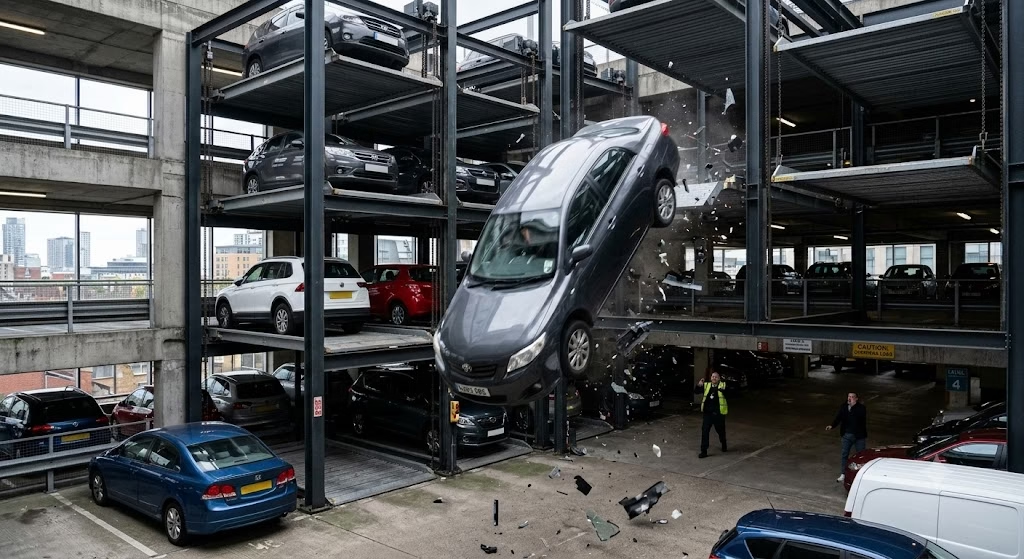
Any machine that lifts heavy vehicles above ground carries risk. Brake faults, sensor errors, power interruptions, worn cables, and human error can all lead to a car slipping, dropping, or colliding with a platform. A falling vehicle can damage the cars below it, injure people nearby, and cause harm that spreads quickly through a crowded basement.
Mumbai Has Seen the Consequences
These risks are not theoretical in Mumbai. In May 2025, a car lift collapsed at the Prathamesh Building, a 21-storey residential tower on Link Road in Borivali West. The lift plunged into a 7-metre-deep pit, trapping two people. One man, Shubham Madamlal Dhuri, was declared dead on arrival at the hospital, and the other, Sunjeet Yadav, suffered a head injury. The BMC and police opened an investigation into the cause.
In August 2026, a car fell into an open lift shaft at Horizon Gold Society in Charkop, Kandivali. The complex was only two years old. Reports said the car lift collapsed as the vehicle was being parked, and the driver was injured and taken to hospital. CCTV footage of the incident circulated widely online, and local reports linked it to the earlier Borivali collapse.
In May 2024, during a severe dust storm, an under-construction metal parking tower collapsed on a busy road near Shreeji Towers in Wadala. Officials reported that several parked vehicles were damaged and three people were injured. The collapsed structure had to be cut apart with gas cutters, and police ordered an inquiry.
Older reports also describe a fatal car lift collapse at a high-rise under construction in Girgaum, where a worker died and four others were hurt. Police registered a negligence case against the construction company’s owner and the site supervisor.
These incidents share a pattern. Mechanical parking can fail suddenly, the damage can reach people who have nothing to do with the car, and investigations can take months.
Liability Can Get Messy
When an accident happens, owners, the society, the builder, and the maintenance contractor may each point to someone else. Disputes can drag on, and insurance may not cover every scenario. Ask whether the building holds a current policy that explicitly covers the parking system, and how past incidents were resolved.
To be fair, many well-maintained stack systems operate safely for years. The risk rises when maintenance is neglected, when the equipment is old, or when the society cannot afford timely repairs. The question is not whether stack parking can work. It is whether this particular building has a good track record and a funding plan that justify the risk.
What Happens to Your Car
Even without an accident, a stack system takes a toll on the vehicle. Cars are positioned on narrow platforms, sometimes with only a few centimeters to spare. Scrapes, dents, and mirror damage can occur from the mechanism or from neighboring vehicles. Larger SUVs and premium cars may not fit at all, which limits who can comfortably live in the building.
The Resale Trap
A flat is also an asset you may need to sell someday. Buyers compare properties carefully, and many avoid buildings with a reputation for unreliable parking. If word spreads that the system breaks down often or that maintenance charges keep rising, your flat may attract fewer buyers or sell for less than comparable homes with conventional parking.
Due Diligence Checklist Before You Sign
Before you commit to a flat in a tower with stack parking, work through these questions with the builder, the society, and current residents:
- What is the current monthly maintenance charge, and how has it changed over the past three to five years?
- Who services the stack system, and when does the annual maintenance contract expire?
- Does the society maintain a sinking fund large enough to replace major components?
- How often has the system failed, and how long did repairs take?
- Has any accident involving the parking system been reported, and how was it handled?
- Is there an occupancy certificate, and does it cover the parking structure?
- Is the project registered under RERA, and has the builder’s record been checked?
Clear, documented answers are a good sign. Vague replies or reluctance to share records are a warning.
The Bottom Line
A flat in a stack parking tower may look like a bargain on the day you visit, but the real cost unfolds over years of maintenance bills, repair delays, safety concerns, wear on your car, and a harder resale. Mumbai’s recent lift accidents show that the risk is not only financial. If the building depends on a mechanical system you do not trust, keep looking, even when the price is tempting. A property with conventional parking or a transparent, well-funded maintenance plan will often serve you better and cost less where it counts.